
Whitley Beaumont – Kirkheaton’s lost stately home

Photo by Smith Carter circa 1910
Courtesy Kirklees image archive k003270
The origins of the fine house which became Whitley Beaumont date back to the time between 1206 and 1211. It was during this time that William de Beaumont was granted two manors in Huddersfield as a reward for his service on the Third Crusade. The earliest reference to a manor house at Whitley Beaumont comes from 1390, although the family claimed they had been there since the reign of Henry III (1216-1272). The manor house may well have begun as a timber-framed building which was then gradually rebuilt in stone. At its heart would have been the great hall with the kitchen and buttery at one end and the lord and lady’s chamber at the other. It would have lain at the centre of a large estate or demesne surrounded by farm buildings.
Over the centuries the house was rebuilt or remodelled several times. One of these reconstructions was carried out by perhaps its most famous owner ‘Black Dick’ or Sir Richard Beaumont in 1630. He represented Pontefract in Parliament, was made a baronet by King Charles I and had an income of £1200 a year (over £1 million in modern money) from his 2,000-acre estate. This allowed him to rebuild the house in the 1630s although he retained some of the existing Elizabethan building. From a fine paid by Sir Thomas Beaumont in 1646 we get the first indication of what the house was like. It included at the very least a great hall, dining room, dining chamber, parlour, seven bedchambers, kitchen, buttery, barns and a gatehouse.
In 1704 Sir Richard Beaumont inherited the house and extended it. A new three storey frontage with 30 bedrooms was added to the existing Elizabethan wings of the hall to form a quadrangle around an inner courtyard. It is a painting of this house made in 1748 which provides us with the first image of what Whitley Beaumont actually looked like.
Fifty years later the house was remodelled again by James Paine, one of the leading architects of his day. He redesigned both the interior and exterior of the house drawing his inspiration from ancient Greek and Roman building styles. Famed for his use of craftsmen he gave the front of the house a much more impressive look and completely changed the interior with his elaborate designs. The Temple, clearly Roman in style and known locally as Black Dick’s Tower, is also attributed to him.
The years between 1752 and 1800 probably saw Whitley Beaumont at its peak. The house already had a grand setting with its serpentine paths, formal avenues and terrace overlooking the moors. Between 1779 and 1784 the grounds of the whole estate were given a makeover. It was to be one of Capability Brown’s last projects. He extended the park to the south, thickened the existing belts of trees as well as planting a lot of new woodland. A new drive and entrance was built along with lodges either side. A grand avenue of trees was also planted leading up to the house.
The house went into a gradual decline after Richard Henry Beaumont inherited it in 1831. He had little time for Whitley Beaumont much preferring his London town house and Clarence Lodge in Surrey. By 1836 the house was closed up and there was no gardener to maintain the grounds. Henry Frederick Beaumont (1833-1913) and his family were the last of the Beaumonts to spend any time there. By the early 1900s the house stood empty with many of its fine rooms stripped and its gardens overgrown. With the death of Henry Frederick and the family now seeing Tetworth Hall as their family seat Whitley Beaumont was put up for sale.
In 1924 local businessman Charles Sutcliffe purchased the hall and restored a small section of it. Although the house was not occupied on a regular basis he used it to entertain guests, e.g. holding dances, garden parties and using the estate for shooting. Following Sutcliffe’s death in 1948 the house and estate were put up for auction. The land was acquired for opencast mining with the house being demolished in 1952. Today much of Capability Brown’s deer park remains but there is no trace of the house. The only structures still standing are the Temple, the Monument and a stretch of wall from the house’s walled garden. In the spring rhododendrons bloom marking where part of the gardens used to be.
JLL March 2026
Sources
Beaumont Papers West Yorkshire Archive
Huddersfield Exposed
Kirkheaton History Group Archive
Kirklees image Archive
Tags for this article:
Recent Archive Posts
Kirkheaton Church-Religious turmoil in Tudor times
When Kirkheaton’s villagers woke up believing in one religion and went to bed following another Few people in Kirkheaton could...

Dalton Grange
Dalton Grange, the house, or rather mansion, was built in 1870 by a Henry Brooke, at that time head of the firm of J. H. Brooke...
Tolson Farmers of Dalton, Kirkheaton and Houses Hill
The Tolson`s seem to have been farming in and around Kirkheaton for quite some time, and in the early 20 century were spread...
When Kirkheaton was known as Hepton (Heptone)
Doomsday book 1086 The traditional view is that Kirkheaton began life as ‘he ton’ or ‘heaton’, which comes from two Olde English...
The Coalman who went to war
The Story of First World war veteran Frank Stancliffe MM The Kirkheaton History Group has carried out a great deal of research...
Kirkheaton St Johns’ Infant School
Kirkheaton St Johns’ Infant School, Fields Rise Memories of Margaret Waddington Aged 86 I first began at the infant school in...
Rawthorpe Lane and the lost hamlet of Lees head, Dalton
6" OS map CCXLVII.16 published 1908 Courtesy of the National Library of Scotland Before 1915 Jagger lane, Kirkheaton;...

Lepton-Lodge Mill Colliery
6 “Ordnance Survey map CCXLVII.SW revised 1948. Courtesy of The National Library of Scotland, showing the location of...
Kirkheaton-Brown Cow Inn
Kirkheaton History-by Geoff Newell My story is of the Hirst family who lived and ran the Inn known as the Brown Cow, which used...
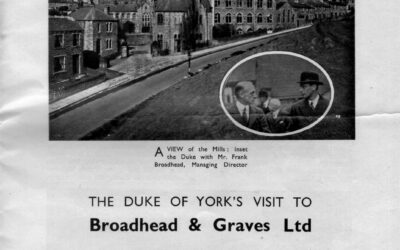
Broadhead and Graves Mill Royal Visit 1932
His Royal Highness, the Duke of York, as President of the industrial Society, visited the Kirkheaton mills of Broadhead and...
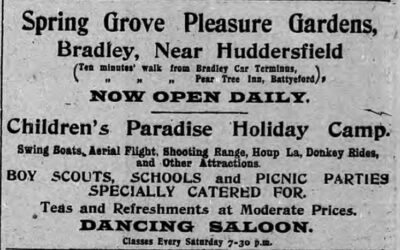
Colne Bridge-Spring Grove Pleasure Gardens
Spring Grove Pleasure Gardens on Paul Lane, Colnebridge (Approximate WhatsApp location "remit.inches.voter") operated between...

Kirkheaton Brickmaking in the 18th Century
Brickmaking has been well established in Birstall Parish for over 50 years, and other sources of good earth in townships such as...

