
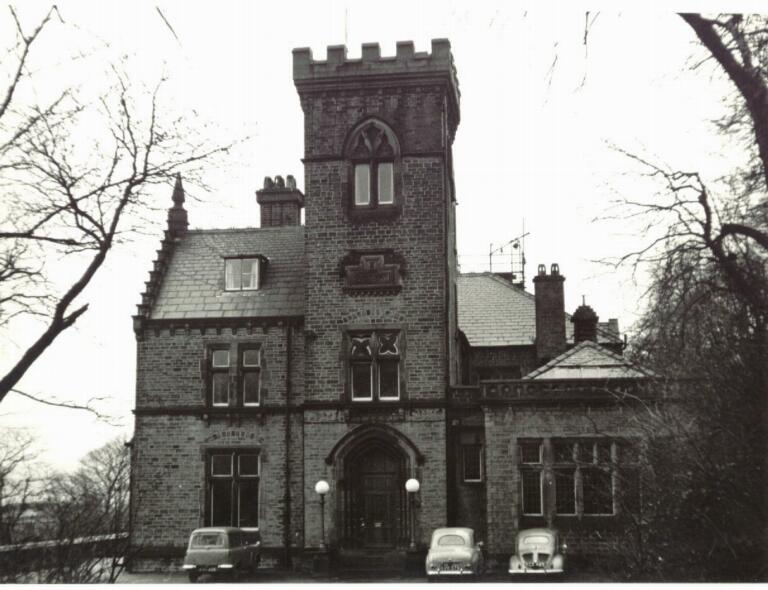
Dalton Grange, the house, or rather mansion, was built in 1870 by a Henry Brooke, at that time head of the firm of J. H. Brooke and Sons, Cloth Manufacturers, of Bradley Mills [1], close to the River Colne and about one and a half miles out of Huddersfield along the Leeds Road. The land on which, or rather into which, the mansion was built had been “common or waste” land until 1811. It had escaped earlier “enclosure,” probably because it had been deemed too steep for this to be worthwhile. All around the land had long since been enclosed to form part of the extensive Lister Kaye estates. But in 1811, under a new Parliamentary Act of Enclosure, a parcel of land of about four acres, the site of the present Grange, was given as an “award of the Manor of Almondbury ” to the benefice of Kirkheaton as an exchange in lieu of Tithes. In late 1869, after it “had been made to appear to the satisfaction of the Ecclesiastical Commissioners that the same land and hereditaments may to the permanent advantage of the estate and endowment belonging to the Rectory be sold,” the Rector of Kirkheaton, Christopher Alderson, in agreement with the Patron of the Benefice, the Reverend George Alderson, Vicar of Hornby [2] in the County of York (obviously a relative), sold the property to Henry Brooke for £500. The hereditament concerned was a fairly large Cottage with outbuildings standing on the verge of Bradley Mills Lane( named Kilner Bank on the map attached to the deeds) and situated somewhere between the site of the present entrance to the Grange by the Lodge [3] and the site of the Grange itself. Of course in those days the land had not suffered the excavations required in building the Grange. Below View Cottage there was a “Potato Field.” It must have been a very nice place with a beautiful view looking North over the trees to the lush water meadows below and the wooded slopes of Fartown beyond. Ten years later, in 1879, Henry Brooke added to his property a further 4.8 acres of land to the East, known in those days as Briery Wood Shrog (or Wood and Shrog) which he bought from the Estate of Sir John Pepys Lister Lister Kaye, Bart., of Denby Grange, when much of that estate was being sold. This new land, stretching down from Bradley Mills Lane, forms the small wood (named the Little Wood on current maps of Huddersfield) The Kaye Estate must have been much more astutely managed than that of the Church, for Brooke gave £2,400 for this acquisition of virtually useless land. Except as an amenity it has remained unproductive ever since.
Henry Brooke lived in Dalton Grange with his wife and three sons for about twelve years. He died in 1883, but not before he had had to hand over the Deeds of the property to the West Riding Union Bank as security for an overdraft of £12,000 incurred by his firm, J. H. Brooke and Sons. This was as early as 1879, very shortly after he had acquired the Shrog; not very good business, it seemed. After his death the Bank required his Executors, his two elder sons, to execute a Mortgage of the Property for £7,568 2s. 6d. at 5 per cent.,the outstanding debt still owing to the Bank. In his Will, Henry had bequeathed all his plate, china, glass, books, pictures, wines, furniture and other household effects and all carriages and horses, etc., upon trust for his family. But there could not have been very much to leave. In 1883 his youngest son, Frederick, joined the firm, but not very long afterwards he emigrated to Canada, going to Vancouver. Joe Brooke stayed on in the Grange until at least 1894. In 1902, when the West Riding Union Bank failed, the Liquidators sold the Property for only £1,000 to W. H. Jessop, Builder, of Moldgreen.
Jessop is believed to have lived in the Grange, but for a time only. In 1916 he was glad to sell it to British Dyes Limited; this time it fetched £2,700. It was used as a social club with some accommodation for works staff closing in 2013.
The property was Grade II Listed on 22 July 2015. [Historic England register1427283] but is now vandalised, probably beyond repair
1.Historically part of the ancient parish of Kirkheaton but along with Dalton and Moldgreen was incorporated into the municipal borough of Huddersfield in 1868.
2.Hornby-near Northallerton
3.Demolished in the late 20th century
Tags for this article:
Recent Archive Posts

Heaton Corn Mill Lepton and Albany house
6 Inch Ordnance survey map OS CCXLV1 SE 1908 -see additional map notes at the end of this article The only watermill for...
Whitley Beaumont- Kirkheaton’s lost stately home
Whitley Beaumont – Kirkheaton’s lost stately home Photo by Smith Carter circa 1910 Courtesy Kirklees image archive k003270 The...

Kirkheaton Jossey Club
The photo above is an enhanced version of the one below donated by the late Jeffrey Hey with names of members shown where known....

Vic Hey-famous Rugby League player with Kirkheaton Roots
Recently, I came across a postcard (above) in our late fathers’ (Jeffrey Hey) photo album which was confusing, as it was...

The Kirkheaton caravan built from a wartime glider
With the end of the Second World War the British government found itself with a surplus of military equipment. Whilst much of it...

Kirkheaton Flood 1935
Kirkheaton Roundabout 2024 Picture by Author A violent storm swept through the West Riding on Easter Tuesday 1935...

Broadhead & Graves mill fire 1964
All design records lost in mill blaze Patterns and design records going back to the firms earliest days were lost in a...

Frank Broadhead
Broadhead and Graves woollen mill This Kirkheaton business on shop lane was a very well known manufacturer of fine...

Lost Colne Bridge
Courtesy Kirklees Image Archive The photograph above shows Colne Bridge in Kirkheaton around 1910 yet none of the buildings in...
Thomas Broadbent’s D-Day Submarine X-20
Thomas Broadbent’s D-Day Submarine X-20 The Broadbent engineering family has a long connection with Kirkheaton dating back to...

D-Day Glider Pilot Sergeant Eric Lightowler
One name that seems to be missing from our local war memorials is that of Eric Lightowler, who was killed in action on D-Day 6th...
Pinion well-the holy well on Liley lane
Until recently a well could be seen just off Liley Lane called Pinion Well. Up to the time of the First World War it was...