
Joshua Beaumont was born into a poor family in Kirkheaton in 1787. It would seem his parents found life a struggle and could not adequately provide for their family. Rather than having young Joshua begging, or possibly roaming the streets causing trouble, the local Overseers of the Poor got him ‘apprenticed out’ to a local farmer for seven years. In effect, he became a slave working on a farm in Almondbury in return for his food and lodgings. Joshua would have been in his mid-teens when this happened. It would have been a very hard life, working long hours in all weathers from around 5 am in the morning until 9 pm at night. By his early 20s, Joshua Beaumont would have been a familiar sight driving carts around the village and was regarded as a ‘capable husbandman’ (farmworker).
On 25th July 1810, with his apprenticeship almost served, Beaumont went out in the evening to a ‘club feast’ for farm labourers held by a friendly society in Almondbury. On his way home and just before 9 pm, he stopped at the house of Lucy Brook on Almondbury Bank. Lucy was a 56-year-old widow who, although not in the best of health, still managed to support herself by doing some teaching. Beaumont may have known her. A neighbour called round briefly to light a candle just after 9 pm and saw the pair having a friendly conversation inside Lucy’s one roomed home.
What exactly happened next, we will never know. However, all the evidence at the time pointed to Beaumont trying to force himself upon Lucy, in an attack which was so violent that she died from her injuries. What happened next is also difficult to determine because of some of the conflicting evidence given at Beaumont’s trial. What is certain is that the first on the scene was a passer by, Thomas Cliff, a clothier who lived nearby. He did not hear any signs of a struggle as he approached Lucy’s house, but he did hear a woman groan as he walked past her door. The door was wide open, so he looked inside. He saw Lucy lying on the floor close to the hearth and Beaumont getting up from her and buttoning his clothes. Cliff went to get help with Beaumont following him and exclaiming ‘she was like a dead pig’. They returned to the house with some local women and lifted Lucy on to the bed. Beaumont was clearly agitated and when mention was made about getting the constable, he left. Not knowing whether Lucy was alive or dead, Cliff left the women with her and went for the doctor. By the time he got there Lucy was long past help.
When the constable arrived and examined the scene, he found Lucy‘s cap on the floor, blood close by along with a poker. Lucy had a black eye; a bloody nose, bruising to her chest and her right arm had a burn from the elbow to the wrist. The constable clearly had grounds to arrest Beaumont. The next day, the coroner called in William Wilkes, a Huddersfield surgeon, to help determine the cause of Lucy’s death. He concluded that she had been the victim of a violent attack and that the injuries sustained were consistent with her struggle against her attacker.

Condemned cell at York
When this sort of evidence was put before the court at York Castle (now York’s Crown Court) three weeks later, the jury took just 15 minutes to find Beaumont guilty. He offered no real defence to the charges against him, nor did any members of his family attend the trial. Being poor, they just did not have the means to get there. Joshua Beaumont was sentenced to death by hanging with the judge ordering that his body be used for dissection by the surgeons of York’s Infirmary. The sentence was carried out behind York Castle at 11 pm on 15th August 1810. A penny broadside (the 19th century equivalent of a tabloid newspaper), published after his execution, purported to give Beaumont’s confession and his last words.

It gave nothing of the kind, but the Leeds Mercury newspaper did highlight one thing in its reporting of the trial. It stated that Beaumont’s behaviour at the trial, suggested to onlookers that ‘he was very little removed from the state of idiotism.’ It suggests, at the very least, a man who had severe learning difficulties and someone who was never going to find life easy in the society of the time.
JL Jan 2024
Sources
- A Narrative of the Trial, together with the Last Dying Words, Speech, and Confession of Joshua Beaumont by W. Storry published in York 1810. Only one known copy exists of the penny broadside.
- The Leeds Mercury (18th August 1810)-page 4 “Summer Assizes”
- The Yorkshire Post (4th March 2023)
- The York Castle Museum and York Castle Prison websites
Tags for this article:
Recent Archive Posts
Tolson Farmers of Dalton, Kirkheaton and Houses Hill
The Tolson`s seem to have been farming in and around Kirkheaton for quite some time, and in the early 20 century were spread...
When Kirkheaton was known as Hepton (Heptone)
Doomsday book 1086 The traditional view is that Kirkheaton began life as ‘he ton’ or ‘heaton’, which comes from two Olde English...
The Coalman who went to war
The Story of First World war veteran Frank Stancliffe MM The Kirkheaton History Group has carried out a great deal of research...
Kirkheaton St Johns’ Infant School
Kirkheaton St Johns’ Infant School, Fields Rise Memories of Margaret Waddington Aged 86 I first began at the infant school in...
Rawthorpe Lane and the lost hamlet of Lees head, Dalton
6" OS map CCXLVII.16 published 1908 Courtesy of the National Library of Scotland Before 1915 Jagger lane, Kirkheaton;...

Lepton-Lodge Mill Colliery
6 “Ordnance Survey map CCXLVII.SW revised 1948. Courtesy of The National Library of Scotland, showing the location of...
Kirkheaton-Brown Cow Inn
Kirkheaton History-by Geoff Newell My story is of the Hirst family who lived and ran the Inn known as the Brown Cow, which used...
Broadhead and Graves Mill Royal Visit 1932
His Royal Highness, the Duke of York, as President of the industrial Society, visited the Kirkheaton mills of Broadhead and...
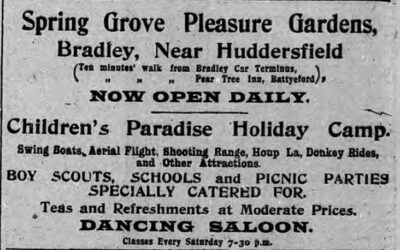
Colne Bridge-Spring Grove Pleasure Gardens
Spring Grove Pleasure Gardens on Paul Lane, Colnebridge (Approximate WhatsApp location "remit.inches.voter") operated between...

Kirkheaton Brickmaking in the 18th Century
Brickmaking has been well established in Birstall Parish for over 50 years, and other sources of good earth in townships such as...
Kirkheaton Cricket Club History
DEVELOPMENT OF THE CLUB Our centenary year celebrates 100 years on this ground at Bankfield. However...
Grange moor-Hit by VI Rocket Christmas Eve 1944
This week Grange Moor, like other places has celebrated VE-day and VE-plus-one-day. During the celebrations the thoughts of the...

