
The Potters of ‘Poter Heton’ (Upper Heaton)
During the 13th and 14th centuries, a small-scale pottery industry was established in the Upper Heaton area. Its importance locally, led to the hamlet being known as ‘Poter Heton’. In the Middle Ages, pottery making tended to be a seasonal occupation and a way for peasant farmers to make extra money. Although very much regarded as a low status occupation and craft in those days, Upper Heaton pottery found its way into the homes of both the rich and the poor.
Digging out brown fireclay from outcrops close to Heaton Hall, the potters then mixed it with river sand from Colnebridge and water from a nearby stream. Perhaps as much as 20% of the finished pots would have been made from sand. The sand helped the clay to dry evenly ready for firing. Uneven drying put stress on a damp pot and led to cracks, as some areas shrank faster than others. This meant the finished pots would have been left to dry in a sheltered spot or workshop rather than being placed outside in the direct sun or wind. Once dry and glazed, the pots were carried to the kilns and fired.
The remains of three kilns were excavated between 1960 and 1962 close to Bog Green Lane in a field belonging to Heaton Hall Farm. It would seem the potters chose the site with some care. Being quite high up, exposed and wind swept, they were trying to get the strongest natural draught to help the firing of their kilns. The kilns were oval shaped with stone walls and built into the ground. They had a flue at either end. The pottery was stacked on the floor of the kiln and then a curved roof was built over the top using interwoven brushwood, rushes, and grass. The underside of this roof was plastered with a sealing layer of clay whilst the top was capped with turf for insolation and protection from the rain. The kilns were fired by burning brushwood from the surrounding woodland.
Three-quarters of a ton of pottery was recovered during the 1960s excavations almost all of which would have been broken, during the firing process, and thrown away. The pieces came from some 2,700 complete vessels, of which 83% were cooking pots. A further 10% were pancheons (mixing bowls often used for making bread), 5% were jugs whilst most of the rest were a mixture of storage jars, dishes, and bowls. Amongst the least common and perhaps bespoke items were skillets, butter pots and a cheese press. However, the potters would seem to have had a clear best seller with just one type of cooking pot making up two-thirds of their production. Some of the excavated pottery came from other potteries, suggesting the Upper Heaton potters were also copying other people’s designs.
The concentration of the Upper Heaton potters on the production of cooking pots reflects the kind of market they served. The local area was thinly populated with most of the people being poor peasant farmers. There were a few wealthy local lords, like the Beaumonts, Hetons, Lascelles and Savilles, but the tax returns from 1279 show that most people in the area did not pay any tax. Using Bog Green Lane, a major thoroughfare in the Middle Ages, the Upper Heaton potters were ideally placed to take advantage of the surrounding local markets. Between 1253 and 1317, regular markets were established in Almondbury, Emley, Thornhill and Elland. There would also have been some passing trade along Bog Green Lane. Most of the Upper Heaton pottery would have been sold locally, especially when the average household broke at least one pot a week. The more expensive items like glazed jugs seem to have been marketed as far afield as the Yorkshire and Derbyshire Dales. They may have been exchanged for things the potters needed. Lime from the Craven area would have been used as a fertilizer, whilst Galena (lead ore) from Derbyshire was needed to make the potters’ trademark green glaze.
Known today as Upper Heaton Ware, the pottery has been found locally in Kirkheaton, Newsome, Slack, Shepley, Birstall, at Thornhill Hall and at Almondbury Castle. Places further afield include Kirkstall Abbey, Ilkley, Peveril Castle in Castleton, Wortley, Monk Bretton Priory and Sheffield Castle. The most distant finds are all jugs with Grassington and Malham being the furthest locations from the pottery. The latter is 35 miles away. The fact the pottery has been found in castles, monastic sites and medieval halls shows that it was not simply being used by peasants.
When, or why, the Upper Heaton pottery ceased production in the 14th century is not known. A land deed refers to Upper Heaton being known as ‘Poter Heaton’ in 1314, so it may have been some time after this date. With people in the Middle-Ages leading such precarious existences, there may be a number of reasons why the pottery went out of use, not least being the victims of disease or famine.
A selection of UpperHeaton pottery, along with a reconstruction of one of the kilns, are displayed in the Tolson Museum.
J L
Sources
Medieval Pottery Kilns at Upper Heaton, West Yorkshire by T. G. Manby.
Yorkshire Deeds (for reference to ‘Poter Heton’), Yorkshire Records Series XXXIX
Yorkshire Lay Subsidy (for 1279 Tax Returns), Yorkshire Record Series, XVI.
Huddersfield Examiner 26 Nov 1960
The Tolson Museum, Ravensknowle Park, Moldgreen, Huddersfield

Medieval Pottery
Tags for this article:
Recent Archive Posts
Tolson Farmers of Dalton, Kirkheaton and Houses Hill
The Tolson`s seem to have been farming in and around Kirkheaton for quite some time, and in the early 20 century were spread...
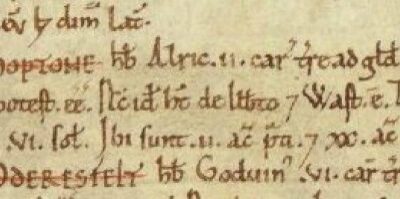
When Kirkheaton was known as Hepton (Heptone)
Doomsday book 1086 The traditional view is that Kirkheaton began life as ‘he ton’ or ‘heaton’, which comes from two Olde English...
The Coalman who went to war
The Story of First World war veteran Frank Stancliffe MM The Kirkheaton History Group has carried out a great deal of research...
Kirkheaton St Johns’ Infant School
Kirkheaton St Johns’ Infant School, Fields Rise Memories of Margaret Waddington Aged 86 I first began at the infant school in...
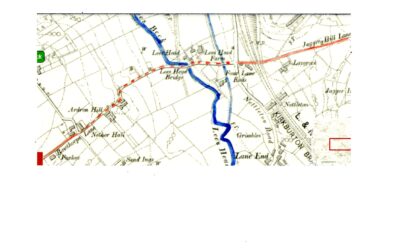
Rawthorpe Lane and the lost hamlet of Lees head, Dalton
6" OS map CCXLVII.16 published 1908 Courtesy of the National Library of Scotland Before 1915 Jagger lane, Kirkheaton;...

Lepton-Lodge Mill Colliery
6 “Ordnance Survey map CCXLVII.SW revised 1948. Courtesy of The National Library of Scotland, showing the location of...
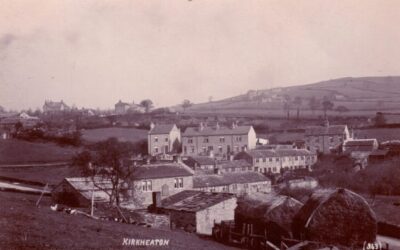
Kirkheaton-Brown Cow Inn
Kirkheaton History-by Geoff Newell My story is of the Hirst family who lived and ran the Inn known as the Brown Cow, which used...
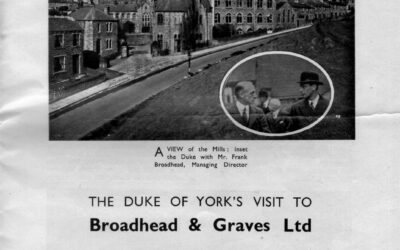
Broadhead and Graves Mill Royal Visit 1932
His Royal Highness, the Duke of York, as President of the industrial Society, visited the Kirkheaton mills of Broadhead and...
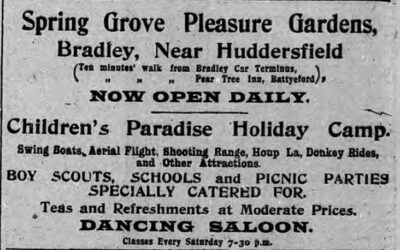
Colne Bridge-Spring Grove Pleasure Gardens
Spring Grove Pleasure Gardens on Paul Lane, Colnebridge (Approximate WhatsApp location "remit.inches.voter") operated between...

Kirkheaton Brickmaking in the 18th Century
Brickmaking has been well established in Birstall Parish for over 50 years, and other sources of good earth in townships such as...
Kirkheaton Cricket Club History
DEVELOPMENT OF THE CLUB Our centenary year celebrates 100 years on this ground at Bankfield. However...
Grange moor-Hit by VI Rocket Christmas Eve 1944
This week Grange Moor, like other places has celebrated VE-day and VE-plus-one-day. During the celebrations the thoughts of the...

